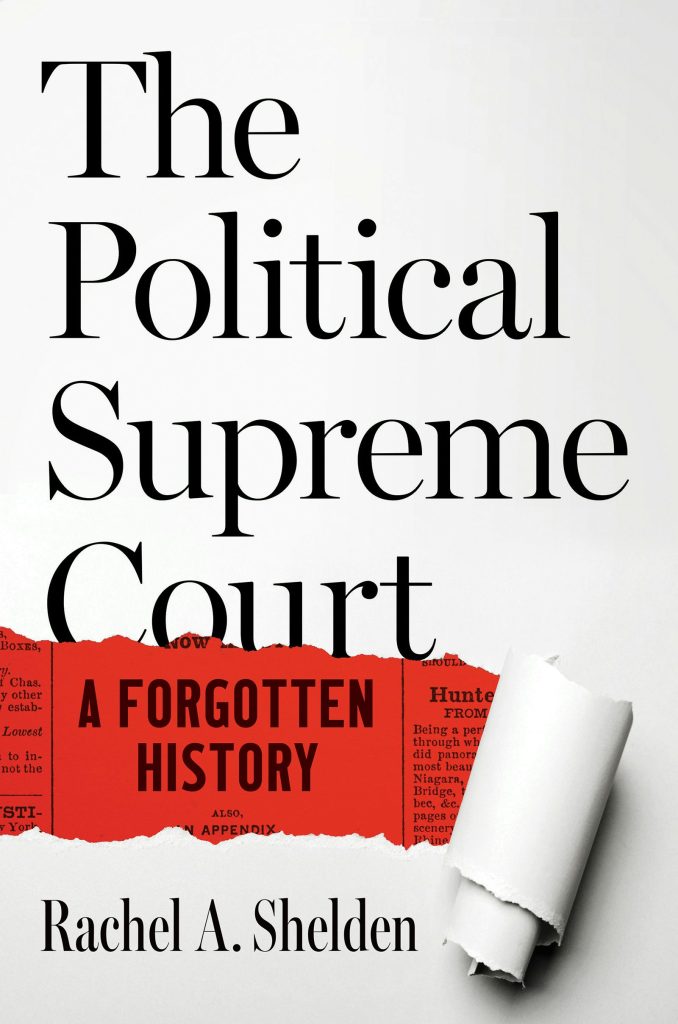
Today’s Supreme Court justices bristle at the label “politicians in robes,” insisting that they operate above the fray of partisan politics. But for the first century of the nation’s history, the Court was unmistakably a political institution, both by design and in practice. Justices were fully expected to engage in partisan politics—there was no concern that such engagement would lead to corruption or undue bias—and they remained deeply involved in civic debate and the electoral process while on the bench. In addition to hearing cases in the capital, each justice spent much of his time “riding circuit” and presiding over federal trial courts. On circuit and in Washington, nineteenth-century justices wrote for partisan newspapers, drafted legislation, advised partisan allies, campaigned for colleagues, and even ran for political offices from the bench. Through these political interactions, members of the Court helped shape debates about the Constitution’s meaning at a time when most Americans did not believe in judicial supremacy.
In this sweeping history, Rachel A. Shelden, one of America’s leading voices on the history of the Court, brings readers inside the social and political world of its justices, recovering their essential role in the era’s turbulent politics. She also charts shifts at the turn of the twentieth century, when members of the Court and the legal community refashioned the judiciary as an apolitical institution, setting the stage for an increasingly more powerful—and more isolated—modern Court. The Political Supreme Court is required reading for anyone interested in the legal and political underpinnings of today’s judicial power.
Available at:
Praise for The Political Supreme Court
“This is the single best book I have read on the history of the US Supreme Court. A remarkable achievement.”—Gautham Rao, author of White Power: Policing American Slavery
“A deeply researched and highly enjoyable study of how politics kept the early Supreme Court accountable—and the most important historical assessment of the nineteenth-century Court in a very long time.”—Stephen Vladeck, New York Times bestselling author of The Shadow Docket: How the Supreme Court Uses Stealth Rulings to Amass Power and Undermine the Republic
“A stunning, original, and important description of the extensive political involvement of Supreme Court justices during the nineteenth century. Shelden is a gifted storyteller. This book will be an essential resource for all looking at this period of Supreme Court history.”—Erwin Chemerinsky, coauthor of Campus Speech and Academic Freedom: A Guide for Difficult Times
“Rachel Shelden compellingly describes the lively political world that nineteenth-century justices inhabited, one that contrasts sharply with the purported neutrality and isolation that our Supreme Court falsely claims to possess.”—Jack N. Rakove, Pulitzer Prize-winning author of Original Meanings: Politics and Ideas in the Making of the Constitution
“Blending commanding research with brisk, accessible writing, Shelden skillfully evokes the political world of the nineteenth-century Supreme Court and explodes the myth that the Court somehow stood above the partisan fray. By illuminating the lives and careers of its justices, both famous and lesser-known, her refreshing narrative demonstrates not only how politics intruded into the Court’s work but also how the Court shaped the nation’s political order.”—Joseph P. Reidy, author of Illusions of Emancipation: The Pursuit of Freedom and Equality in the Twilight of Slavery
Today’s Supreme Court arrogantly and disingenuously disclaims any political role. Shelden’s The Political Supreme Court punctures this myth with a vivid history of the Court’s entanglement with politics in an earlier time. As the modern Court remakes the fabric of constitutional law in its own political image, this book is a crucial reminder of the forces that drive constitutional meaning-making and of the possibilities for a more open reckoning with them.” —Duncan Hosie, Director, Stanford Constitutional Law Center